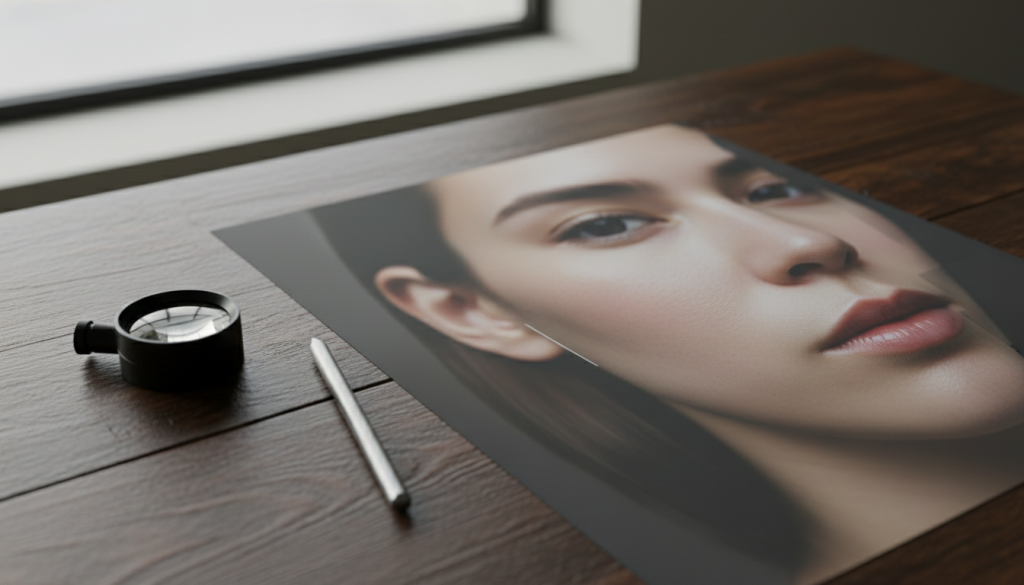
Automated dermal cleanup operates effectively under fixed spatial receptive fields during an ai retouching pass across planar studio portraits, but this deterministic processing breaks down whenever subject depth shifts sharply across the optical plane. The limitation stems from the computational design of pixel-level inference engines. While neural filters analyze local gradients to neutralize blemishes or soften uneven transitions, they evaluate spatial tiles within confined mathematical receptive fields rather than interpreting the physical structure of light falling across a three-dimensional subject.
The Structural Constraint of Receptive Windows
Every neural network applied to raster imagery processes input through convolutional kernels or attention patches of finite pixel dimensions. This operational footprint defines the system’s effective receptive field. Within this boundary, the engine calculates statistical deviations in color values and local contrast, determining which pixels belong to clean skin structure and which represent transient flaws. It evaluates proximity, not scene topography.
To understand the breakdown, one must separate the term “semantic understanding” from the actual mathematical routine: the execution of spatial statistical clustering. A software suite does not comprehend anatomical feature logic, such as the edge of an ear cartilage or the falloff of a jawline into rim light. It calculates local luminance variance across a discrete matrix. When an editor feeds an image containing variable focal depths, the algorithm measures out-of-focus areas using identical threshold formulas established for sharp foreground planes.
Downstream Consequences: Texture Erasure and Edge Haloing
Because the network evaluates local variance without global spatial orientation, a cascade of unintended artifacts enters the edit:
- Micro-texture obliteration in transition zones: Where a cheek rounds away from the lens, natural optical falloff softens the skin grain. The algorithm flags this lower-frequency region as an uneven color blotch and applies aggressive averaging, transforming gentle focus rolloff into a flat, plastic band.
- False positive edge erosion: Around high-contrast boundaries—such as the perimeter of nostrils, the line of the lips, or fine flyaway hairs over the neck—the model misidentifies sharp luminance transitions as surface irregularities. The consequence is localized edge softening, leaving an editor with halo-like smudges that require destructive manual masking to undo.
- Inconsistent grain reproduction: In multi-subject commercial frames or portraits with wide apertures, background faces receive identical smoothing passes despite existing outside the lens’s depth-of-field plane. This creates an optical impossibility: skin smoothed to a uniform sharpness sitting inside an optically blurred spatial zone.
Compensating for Fixed Inference Boundaries
Avoiding these systematic errors requires structuring retouching operations around strict layer isolation rather than continuous global passes. An editor cannot run an inference tool over a full-resolution canvas and expect mechanical uniformity across differing depth zones.
In practice, this means constraining the neural pass through selective luminance and depth mattes before the algorithm computes its changes. By restricting processing to the plane of critical focus, the editor prevents the model from interpreting low-frequency bokeh as skin defects. When secondary subjects or background transitions require tone adjustment, they must be partitioned into separate passes with adjusted input parameters that account for their reduced spatial frequency.
This structural limitation ceases to apply when processing flat-field catalog work, frontal documentary headshots captured at narrow apertures like f/8 or f/11, or macro beauty photography where depth of field remains strictly parallel to the sensor. In those optical configurations, the lack of depth variation matches the native operational assumptions of the receptive field, allowing the filter to perform without distorting the physical geometry of the image.